平成23年4月1日
お客様各位
オー・オー・シー・エル(ジャパン)株式会社
カスタマーサービス部
(訂正)危険物積載タンクコンテナに関して必要書類ご提出のお願い
貴社ますますご盛栄のこととお慶び申し上げます。平素は格別のご高配を賜り、厚く御礼申し上げます。
このたび輸出される危険物積載タンクコンテナに関して、安全性確保の為、ブッキング依頼者であるお客様から「タンクコンテナ証明書」と「LOI (Letter of Indemnity)-念書)」を船積み前にご提出をして頂くことになりました。
下記事項にご注意の上、ご用意お願いします。
* 「LOI」署名者はタンクコンテナ管理者である荷主様 又は、タンクオーナー様です。
* 船入港48時間前の事前積載許可を取るために72時間前に提出をお願いしています、「危険物仮明細書」または、「コンテナ危険物明細書」を弊社DGチームに送付される際に、 上記2種類も送付願います。
* LOI」「タンク証明書」の入手が遅れる場合は、CYカット日午前中までに 弊社DGチームに送付。 アメリカ航路の場合は書類上の閉め日である入港3日前までにお願いします。
* 事前積載申請と上記2種類の書類のご提示がなき場合は、船積み許可が下りませんのでご容赦願います。
実施日 : 2011年4月4日以降日本に寄港する本船から。(船名に関しては別途案内<*>参照願います。)
http://www.oocl.com/japan/jpn/localinformation/localnews/2011/dgtankctrletter.htm
対象貨物 : 残量含む 危険物搭載のタンクコンテナ(ISOタンク、温度管理を必要とするタンクコンテナ、MEGC(Multi-Element Gas Container/ガス集合容器など)
*「LOI(Letter of Indemnity/念書)」参考用紙http://www.oocl.com/japan/jpn/localinformation/eforms/
* 弊社のタンクコンテナに関しての取り扱いガイドライン 参考資料
次項参照
Tank Types and DG Document Requirements for Each
Note: The DG documents indicated below are to be collected as a condition of approval and should be uploaded to Shipment Folder on MOC for filing and retrieving. This is true for OOCL bookings on OOCL vessels, OOCL booking on partner line vessels, and partner line bookings on OOCL vessels. Any question regarding these documents should be forwarded to the Territory DG Coordinators.
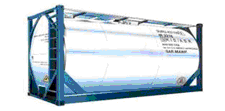
Tank Container
A tank container is a portable bulk tank that is designed with a framework that is compatible with standard sized ISO containers to contain solids, liquids or liquefied gases.
Documentation requirements:
1. LOI (letter of indemnity). The LOI should not limit liability and should cover vessel transport. For tanks loading on partner line vessels the LOI must be submitted with the DG application.
2. Tank Certification also known as the Tank Container Periodic Inspection Report or The Construction Initial Inspection Certificate issued for new tanks. A current copy of the tank certification must be provided. The tank certification should be reviewed to ensure the certification is not out of date. For tanks loading on partner line vessels the certification must be submitted with the DG application.
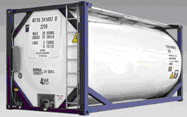
Temperature Controlled Tank Container
A tank container that is under temperature control must be plugged into to a power source on the vessel or on dock to maintain its temperature. The set temperature may be higher or lower than the ambient temperature (it may be heated or cooled).
Important Note: items may be under temperature control for either quality control purposes or product stability. Quality control means that the product quality may suffer if not under temperature control but no negative reaction of the product would occur if not under temperature control. Chemical stability means that the temperature must be maintained or the product will negatively react. OOCL does not accept any DG that is under temperature control for chemical stability reasons in tanks or reefer containers alike.
Documentation requirements:
1. LOI (letter of indemnity). The LOI should not limit liability and should cover vessel transport. For tanks loading on partner line vessels the LOI must be submitted with the DG application.
2. Tank Certification also known as the Tank Container Periodic Inspection Report or The Construction Initial Inspection Certificate issued for new tanks. A current copy of the tank certification must be provided. The tank certification should be reviewed to ensure the certification is not out of date. For tanks loading on partner line vessels the certification must be submitted with the DG application.
3. Tank Operation Manual that shows instructions on how to operate and if needed troubleshoot and or conduct minor repairs. The loading vessel must receive a copy of the manual. To accomplish this, the manual must be provided to the OOCL vessel for tanks loading OOCL vessels. For tanks loading on partner line vessels the manual must be provided with the DG application submitted.
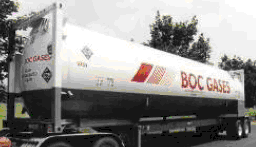
Helium Tank Container
A Helium tank is a tank container that is specifically built to hold liquid helium (UN1963). The helium is kept in liquid form because it is under pressure and temperature control. The temperature is controlled by a nitrogen source within the container itself. These containers do not require any external power. These containers generally will require daily monitoring of the pressures for the helium and nitrogen. There are gauges that the crew will take readings from, and the readings are then reported to the shipper by the vessel crew.
Documentation requirements:
1. LOI (letter of indemnity). The LOI should not limit liability and should cover vessel transport. For tanks loading on partner line vessels the LOI must be submitted with the DG application.
2. Tank Certification also known as the Tank Container Periodic Inspection Report or The Construction Initial Inspection Certificate issued for new tanks. A current copy of the tank certification must be provided. The tank certification should be reviewed to ensure the certification is not out of date. For tanks loading on partner line vessels the certification must be submitted with the DG application.
3. Tank Operation Manual shows instructions on how to operate and if needed troubleshoot and conduct minor repairs on the tank. The loading vessel must receive a copy of the manual. To accomplish this, the manual must be provided to the OOCL vessel for tanks loading OOCL vessels. For tanks loading on partner line vessels the manual must be provided with the DG application submitted.
4. Monitoring Instructions that indicate how to and how often to take helium pressure and nitrogen pressure readings. The instructions must also indicate where the readings are to be emailed to. The instructions must be provided to the OOCL vessel for tanks loading OOCL vessels. For tanks loading on partner line vessels the instructions must be provided with the DG application submitted. In many cases the monitoring instructions may be part of the Tank operating manual itself.
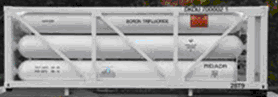
MEGC (Multi Element Gas Container) also know as tube trailers
Multi Element Gas Containers are used for gases (class 2.1, 2.2, 2.3) under pressure. They are groups of cylinders banded together in a framework that is compatible with ISO containers. In most cases MECG container are only half high vs. full height containers.
Documentation requirements:
1. LOI (letter of indemnity). The LOI should not limit liability and should cover vessel transport. For tanks loading on partner line vessels the LOI must be submitted with the DG application.
2. Tank Certification also known as the Tank Container Periodic Inspection Report or The Construction Initial Inspection Certificate issued for new tanks. A current copy of the tank certification must be provided. The tank certification should be reviewed to ensure the certification is not out of date. For tanks loading on partner line vessels the certification must be submitted with the DG application.
